Why some mattresses last 20+ years and others just two.
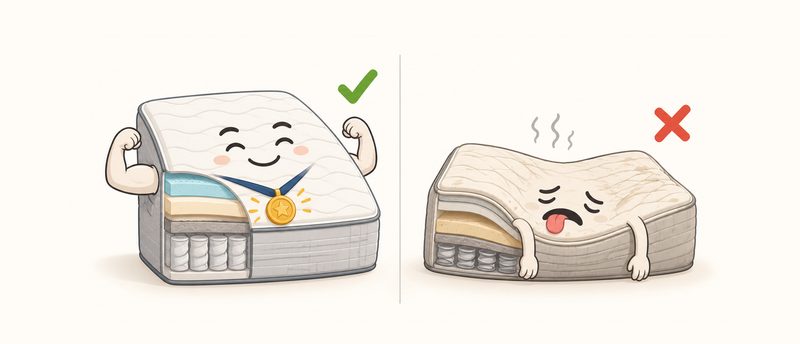
There are mattresses that retain their shape, supportive properties, and comfort even after many years of use. And there are those that show dips, compaction, and signs of material fatigue after a relatively short period.
The difference isn't always visible on day one. A new mattress in a showroom can feel perfectly acceptable regardless of what lies beneath the cover. The true quality of materials reveals itself later — after hundreds of nights, thousands of position changes, and prolonged pressure concentrated on the exact same areas.
What dictates whether a mattress will be a short-term purchase or a reliable sleep companion for years to come?
1. What is actually underneath the cover?
A mattress may look flawless on the outside, but its longevity is primarily determined by the quality of its internal fillings. It is not just the name of the material that matters — whether latex, polyurethane foam, memory foam, or springs — but its quality, origin, density, thickness, and precise role within the overall construction.
Two visually identical foam layers can perform radically differently when it comes to shape retention. Lower-density materials typically lose their initial resilience much faster, whereas high-quality foam suited to the intended weight load can repeatedly compress and recover its original shape for years.
Therefore, a simple label stating "foam" or "latex" is never enough. Always ask about the specific material type, density, composition, layer thickness, and its functional purpose inside the mattress.
2. Does the mattress structure suit the sleeper's weight?
The exact same mattress can perform very differently for different people. A load that is perfectly fine for a lighter sleeper may prove too demanding for the mattress architecture under a heavier body weight.
This does not mean that a heavier individual necessarily needs an excessively hard mattress. However, its core, comfort layers, and total height must be robust enough to prevent the body from sinking too deeply, ensuring the weight load is distributed evenly.
Very thin mattresses require extra caution — they simply contain less material volume to absorb and dissipate long-term pressure.
3. Is there thoughtful synergy between the layers?
A great mattress is more than just the sum of individual high-quality components. A durable construction operates as an integrated system: the core handles the primary load, the intermediate layers distribute it, and the top layers provide adaptive body conformity and comfort.
If a very soft or thin material is placed over an incompatible base, it will deform much faster. If a spring system is not adequately protected by a dense buffer layer, its localized pressure can damage the upper comfort layers. Every layer must be high in quality and correctly matched to the specific internal architecture.
4. Does the manufacturer disclose technical specifications transparently?
A quality mattress should be easy to explain. As a buyer, you have every right to know what it is made of, the exact thickness of the layers, the density of the foam or latex, and the specific spring system built into its core.
Be cautious of product descriptions dominated by fancy material marketing names but lacking technical specifics. Technical parameters are what allow you to objectively compare not just price and initial feel, but long-term durability.
5. Can the mattress be opened, inspected, and restored?
A removable cover isn't just for easier cleaning and hygiene. It allows you to inspect the actual state of the interior fillings, catch early signs of moisture or material wear, and in some cases, replace only a damaged or worn-out layer.
When a mattress structure is accessible and serviceable, its overall lifespan can be extended significantly. There is often no need to discard an entire mattress simply because the cover or a single comfort layer has worn out over time.
6. What type of bed base will support the mattress?
Even a top-tier mattress can suffer premature sagging if placed on a curved, unstable, uneven, or unsuitable bed base. Excessively wide gaps between slats, lack of central support on a double bed, or a warped frame create uneven stress points within the mattress itself.
Before purchasing a new mattress, it is essential to inspect not only the bed frame dimensions, but also the base's flatness, stability, ventilation, and central support structure.
7. Will the mattress receive proper care and maintenance?
Longevity is heavily influenced by daily use. Regularly rotating the mattress helps distribute wear evenly and prevents a single area from constantly bearing the full body weight. Furthermore, adequate ventilation, moisture control, a protective mattress cover, and timely hygiene care maintain a healthy sleep environment while safeguarding the filling from moisture-induced degradation.
A mattress is damaged not only by moisture and stains, but also by concentrated mechanical stress — jumping, sitting repeatedly on the same spot or edge, and weight loads exceeding the design limit.
8. Will the comfort endure beyond the first impression?
An ultra-soft, deeply sinking surface can feel immediately luxurious in a showroom, but you must evaluate whether there is a stable and durable support structure underneath. On the flip side, an extremely firm mattress is not automatically more durable — low-quality firm materials can still pack down, harden unevenly, and lose their supportive properties.
A good mattress balances two elements: comfort tailored to your body and an internal structure capable of sustaining that comfort over time.
A durable mattress isn't always the most expensive one
A higher price tag alone does not guarantee a longer lifespan, just as a more affordable mattress isn't inherently inferior. What matters is understanding what you are paying for: material quality and density, engineering precision, craftsmanship, and the ability to service or restore the mattress later — versus mere cosmetic presentation and brand marketing.
Even a "20+ year" claim isn't a universal guarantee for every sleeper. Lifespan always depends on the specific model, user weight and habits, the bed base, maintenance routine, and whether the mattress continues to provide ergonomic, personalized comfort throughout those years.
Questions to ask before buying a mattress:
• What specific materials are used, and what is the exact thickness of each layer?
• What is the density of the foam or natural latex?
• What weight capacity and sleeping positions is this construction engineered for?
• What type of bed base is required for optimal support and warranty compliance?
• Is the cover removable and washable/cleanable?
• Can the mattress be opened for inspection, spot repair, or component replacement?
• What is the recommended rotation and maintenance schedule?
• What specific components and issues are covered under the warranty?
A great mattress isn't built just to make a good first impression. Its true quality is proven in its ability to maintain its shape, resilience, and essential body support year after year. Those are the qualities that truly matter — the ones you can rely on for a very long time.