One is lighter, the other significantly heavier. One prefers a softer surface, the other requires more stable support. Is the only solution really two separate mattresses?
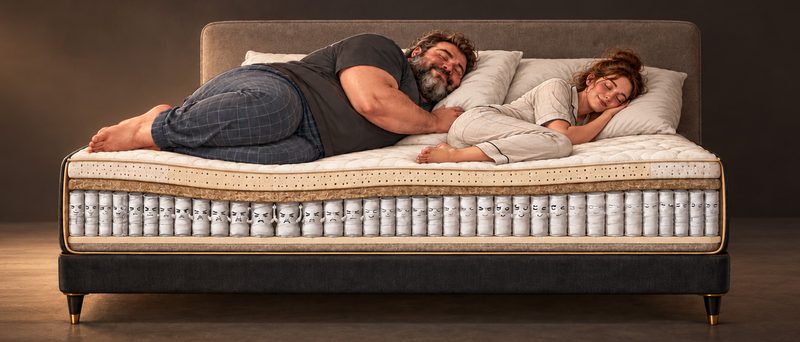
Even with a significant difference in body weight, it is entirely possible to choose a single, continuous mattress without a seam down the middle. However, in such cases, relying solely on dynamic tags like "soft," "medium," or "firm" is not enough. You must evaluate the overall engineering of the mattress—its ability to respond to varying loads, maintain structural support, and simultaneously provide personal comfort for both sleepers.
Why does the same mattress feel different to each person?
Mattress firmness is not an absolute sensation. How soft or firm a mattress feels is largely determined by an individual's body weight and physical proportions.
A heavier individual sinks deeper into the mattress, engaging its core dynamic response. A lighter person mostly experiences the top comfort layers and may not compress the core deeply. Consequently, the very same mattress might feel springy and contouring to the heavier partner, yet noticeably firmer to the lighter one. Rather than searching for a theoretical "average" middle-ground, the key is to choose an internal structure with a wide, adaptive reaction range.
Key factors to consider:
Core Support Reserve
The mattress core must primarily accommodate the heavier sleeper, preventing the pelvis from sinking too low and keeping the spine properly aligned. However, this doesn't automatically mean opting for an extra-hard mattress. An excessively rigid surface can be uncomfortable for the lighter partner, particularly when side-sleeping, as shoulders and hips won't sink adequately, causing pressure points and poor spinal alignment. The goal is deep, progressive resistance rather than surface hardness.
Locally Responsive Design
When accommodating weight differences, a system that yields strictly at the point of pressure—without disturbing the rest of the surface—is essential.
High-density, individually encased Multipocket springs react precisely to localized contours and weight. Under greater weight, the springs compress deeper to offer stronger counter-pressure, while under lighter pressure, they compress minimally. This allows a continuous spring system to deliver distinct support profiles on each side of the bed.
Elastic Comfort Layers
Positioned above the spring unit, materials must adapt to body contours without flattening under heavy load.
Elastic natural latex layers assist by:
• Distributing pressure evenly across contact points;
• Allowing hips and shoulders to sink comfortably;
• Filling in lumbar and bodily curves;
• Instantly recovering shape as you move;
• Unifying both sleep areas into one seamless, level surface.
Progressive Compression
A suitable mattress shouldn't feel flat or stiff. It should offer an inviting, gentle surface yield, followed by increasing structural resistance as load increases. The lighter sleeper engages the gentle upper comfort layers, whereas the heavier partner compresses through to the dynamic spring core and stabilizing bases. This multi-layered behavior is what allows one mattress to perform differently for two distinct bodies.
Motion Isolation
Significant weight disparity can amplify surface motion if the springs are interconnected. Independent pocketed springs and buoyant natural comfort layers isolate movement, preventing tossing, turning, or getting out of bed from waking your partner. However, total immobility shouldn't compromise the natural elasticity needed to switch sleeping positions effortlessly.
Edge & Center Alignment
If the heavier partner sleeps near the edge or sits on the perimeter frequently, reinforced edge support is critical. Additionally, inspect the bed frame itself. Wide double beds require a robust center beam with middle support legs to evenly transfer load to the floor. Even the highest-grade mattress cannot offset a bowing or poorly supported bed base.
Weight Capacity and Material Durability
Always verify whether the manufacturer's weight capacity rating applies per side or to the mattress as a whole. For couples, individual load per sleeping zone is the metric that matters.
Because materials undergo deeper daily compression under heavier weight, special emphasis must be placed on:
• High load-capacity spring configurations;
• High-density, resilient natural foam and fiber layers;
• Quality stabilizing layers;
• Overall height and internal material reserves;
• A sturdy slat or foundation base.
Regularly rotating the mattress head-to-toe as recommended by the manufacturer helps balance long-term wear, though rotation should complement—not replace—properly engineered support.
How to test the mattress in a showroom:
Lie down together on the display models.
Assume your real, habitual sleeping positions.
Pay close attention to spinal alignment at the shoulders, waist, and hips.
Ensure the heavier partner receives sufficient core support without bottoming out.
Confirm the lighter partner doesn't experience harsh surface resistance or pressure points.
Turn over, sit up, and shift weight to test motion transfer real-time.
Check perimeter firmness along the edges.
Take your time—give your body a few minutes to relax into its natural posture.
When is a single continuous mattress NOT the best choice?
Even the most versatile adaptive construction has limits. Dual-core options or split firmness zones inside a single cover should be considered if:
• Comfort preferences are fundamentally opposite;
• One partner requires an ultra-soft surface while the other needs extreme firmness;
• Extreme weight differences coincide with completely contrasting sleeping positions;
• Specific orthopedic or medical needs must be met;
• Showroom testing reveals that a single setup forces one partner into discomfort.
The Bottom Line
Choosing a mattress for partners with a large weight difference isn't about finding a mattress that feels identical to both. It's about choosing a mattress that responds correctly to each unique body. The heavier sleeper requires core stability and support reserves; the lighter sleeper needs surface elasticity and pressure relief. When engineered into a unified multi-layer system, a single mattress delivers the perfect shared solution.
Recommended OSSOV Models:
If you want a continuous, seamless mattress designed to adapt smoothly across differing body weights, we invite you to explore:
• Royal Multipocket Gold Delux
• Longmultipocket Gold Delux
• Soft Silk Wool
• Minipocket Grand Heaven
• Lagoon Relax Sleep
• SkySoft Modular Blue
Each model carries a distinct feel and material profile, so selection shouldn't rely solely on basic firmness tags. We welcome both partners to test these models together at our concept showrooms to experience the real-time difference in person.