Self-check quiz
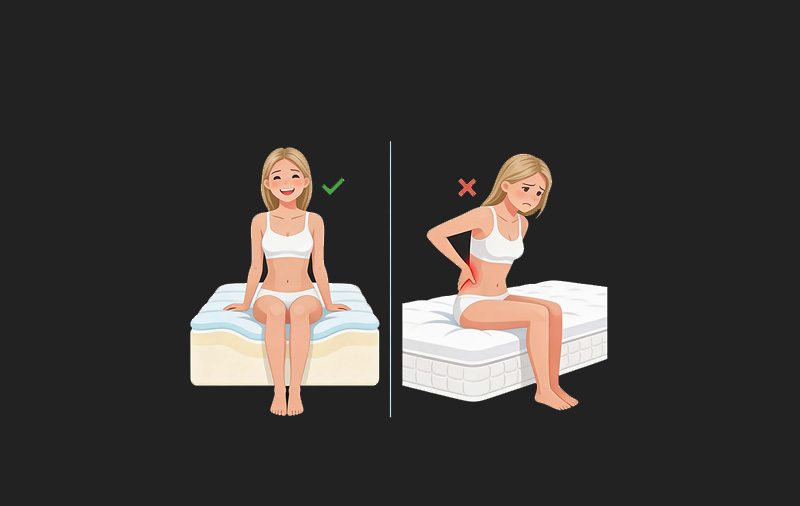
1. Do you feel rested in the morning, rather than stiff and exhausted?
How you feel in the morning is one of the simplest indicators of sleep quality. If you regularly wake up tired, stiff, or feeling unrefreshed after getting enough sleep, your mattress may not be providing you with the right support and comfort.
2. Do you wake up free from pulling pain in your shoulder blades, lower back, or waist area?
Pain that is most noticeable in the morning and gradually eases after moving around can be related to your sleep conditions. A mattress may be too firm, too soft, lost its original shape, or failed to support your body evenly.
3. Do you sleep through the night without constantly tossing and turning to find a comfortable position?
Changing positions during sleep is natural, but frequent tossing and turning can indicate that your body is trying to avoid uncomfortable pressure or insufficient support. A suitable mattress should help your body relax rather than force it to constantly search for a better position.
4. Are your arms, shoulders, or hips free from numbness while sleeping?
Numbness can occur when excessive pressure builds up in the shoulder or hip area and the mattress fails to adapt adequately to the body's contours. However, regular or prolonged numbness can have other causes, so it should not automatically be attributed solely to the mattress.
5. Do you look forward to crawling into your bed at night?
A good bed creates a pleasant sense of relaxation, peace, and physical comfort. If you instantly feel uncomfortable upon lying down or anticipate a restless night ahead, this emotional reaction can also signal that your bed is no longer associated with quality rest.
6. Do you sometimes sleep better in another bed than in your own?
If you wake up feeling more refreshed and tension-free in a hotel or guest room, it is worth considering how that bed differs from yours. The difference might lie in the firmness, elasticity, body support, or pillow height.
7. Is your mattress free from visible dips, clumps, or noticeable unevenness?
As a mattress ages, its materials can gradually lose their original elasticity and uniformity. Not every minor change in shape is a defect, but a pronounced dip, lump, or a feeling that your body is being shifted to one side can interfere with proper support.
8. Does your mattress still suit your body and sleeping habits?
Even a high-quality and undamaged mattress may no longer be the best fit for you after several years. Body weight, health conditions, sleeping postures, pressure sensitivity, or preferences for softer or firmer support can all evolve over time.
9. Have you noticed a nasal congestion, eye redness, watering, or itching that is particularly noticeable in the bedroom?
Such symptoms are not always related to the mattress, but it is worth checking the entire sleep setup. Over time, dust and dust mite allergens can accumulate in the mattress and bedding, while insufficient ventilation and elevated humidity can encourage mold growth.
10. Is your mattress adequately ventilated and supported by a suitable bed base?
What lies beneath your mattress also affects its performance. A sagging, uneven, or improper bed base can distort the mattress's shape and compromise body support, while insufficient airflow leads to moisture accumulation and shortens the lifespan of the materials.
How many times did you answer "no"?
A single negative answer does not mean your mattress needs to be replaced immediately. However, if you recognized your daily reality in several of these questions, it is worth taking a closer look at your mattress, its base, and the overall condition of your sleep setup. Sometimes rotating the mattress, fixing the base, or choosing a more suitable pillow is enough, but other times your body is clearly signaling that it is time to look for a new solution.